
A floor now has to do more than look right in a finished space. In offices, clinics, retail units, schools and mixed-use developments, commercial flooring design trends are being shaped by how people actually use buildings - how they move through them, how often they clean them, and how long the surface needs to perform before refurbishment becomes necessary.
For architects, interior designers, contractors and facilities teams, that changes the conversation. The current direction is not about choosing a fashionable finish and hoping it lasts. It is about specifying floor systems that support traffic levels, maintenance routines, acoustic control, safety requirements and brand presentation at the same time.
What is driving commercial flooring design trends?
The strongest shift is practical. Commercial clients are asking for surfaces that reduce lifecycle cost, not just upfront cost. A floor that looks good on handover but shows wear quickly can become expensive in operation, especially in busy lobbies, corridors, meeting areas and public-facing spaces.
At the same time, interiors are expected to feel warmer and more considered than they did a few years ago. Many workplaces no longer want hard, cold finishes throughout. Healthcare and education settings also want materials that feel welcoming without compromising hygiene or durability. That is why current specifications often balance performance with a softer visual language - more wood effects, more textural variation, and more careful zoning between active and quiet spaces.
Another factor is installation reality. Designers may like a material in principle, but the final decision often depends on subfloor condition, installation speed, downtime, moisture risk and future repairability. The flooring trends gaining traction are the ones that work on site as well as on a mood board.
Commercial flooring design trends in material selection
Natural-looking finishes remain in demand
Timber visuals continue to perform strongly across commercial interiors, but with a more restrained approach than before. Instead of highly glossy or heavily patterned surfaces, clients are leaning towards calmer grains, mid-tone woods and matte finishes that make a space feel professional and current.
This is one reason engineered wood, laminate, vinyl and SPC formats with realistic wood visuals are seeing continued interest. They give specifiers flexibility. In a premium office reception, engineered wood may be appropriate for a more authentic finish. In higher-traffic zones or fit-outs where maintenance and moisture resistance matter more, vinyl or SPC can deliver a similar design direction with different performance advantages.
The trade-off depends on the project. Real wood brings warmth and character, but it also needs the right environment and maintenance plan. Resilient alternatives can be easier to manage in demanding commercial settings, especially where cleaning frequency is high.
Stone and concrete looks are becoming more refined
Hard, mineral-inspired finishes are still relevant, but the trend has moved away from harsh industrial styling. Today, concrete looks are often softer in tone and more controlled in texture. Stone visuals are being selected for a cleaner, more contemporary appearance rather than a dramatic statement.
These finishes work well in retail, hospitality common areas and corporate environments that want a modern look without visual clutter. They are also useful when a project needs to hide dirt and wear between cleaning cycles more effectively than a flat plain colour.
Carpet is being used more strategically
Carpet has not disappeared from commercial design. It is simply being used with more purpose. In workplaces especially, carpet tiles remain relevant where acoustic comfort, underfoot softness and replaceability matter.
What has changed is the way they are specified. Instead of broadloom-style uniformity, designers are using carpet tile layouts to define zones, manage circulation and introduce subtle pattern without overwhelming a space. This is particularly effective in meeting suites, collaborative areas and executive offices, where a quieter environment supports the way the room is used.
Performance-led design is now part of the aesthetic brief
Durability is expected, not optional
The most durable floor is not always the most suitable one, but durability is now a baseline expectation in most commercial projects. Clients want resistance to indentation, abrasion, staining and rolling loads, especially in offices with mobile furniture, healthcare spaces with equipment movement, and retail environments with frequent footfall.
That is why specification conversations increasingly focus on use class, wear layer, impact resistance and maintenance requirements early in the project. A good-looking surface with weak performance data is less likely to make it through value engineering than it once was.
Acoustic comfort matters more than before
One of the clearest commercial flooring design trends is the rise of acoustic awareness. Open-plan offices, education facilities and mixed-use buildings are paying more attention to sound transmission and footfall noise. Flooring plays a direct role here.
Softer surface systems such as carpet tile help reduce noise, while resilient flooring options can be paired with suitable underlays or construction methods to improve acoustic performance. The right solution depends on the build-up and the building type. There is no single answer, but there is a clear trend towards flooring being treated as part of the acoustic strategy rather than a separate finish package.
Safety and hygiene remain central in key sectors
In healthcare, education, back-of-house commercial areas and institutional settings, slip resistance, cleanability and hygiene are not secondary concerns. They are core design criteria.
That does not mean these spaces have to look clinical. One of the more useful shifts in the market is the wider availability of floor finishes that meet practical safety and maintenance needs while still offering a more welcoming visual finish. For decision-makers, this opens up better design choices without stepping away from operational requirements.
Zoning and wayfinding through flooring
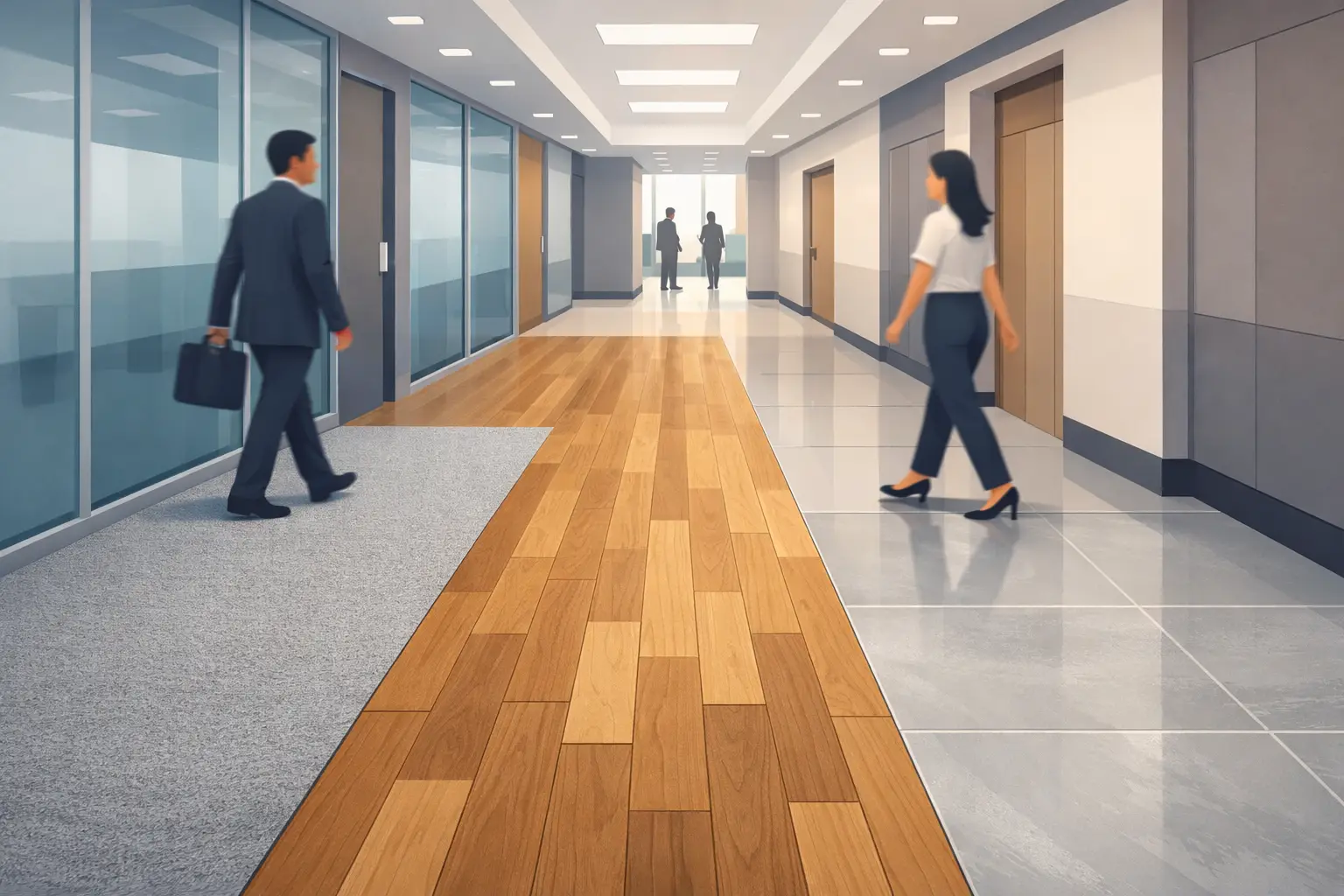
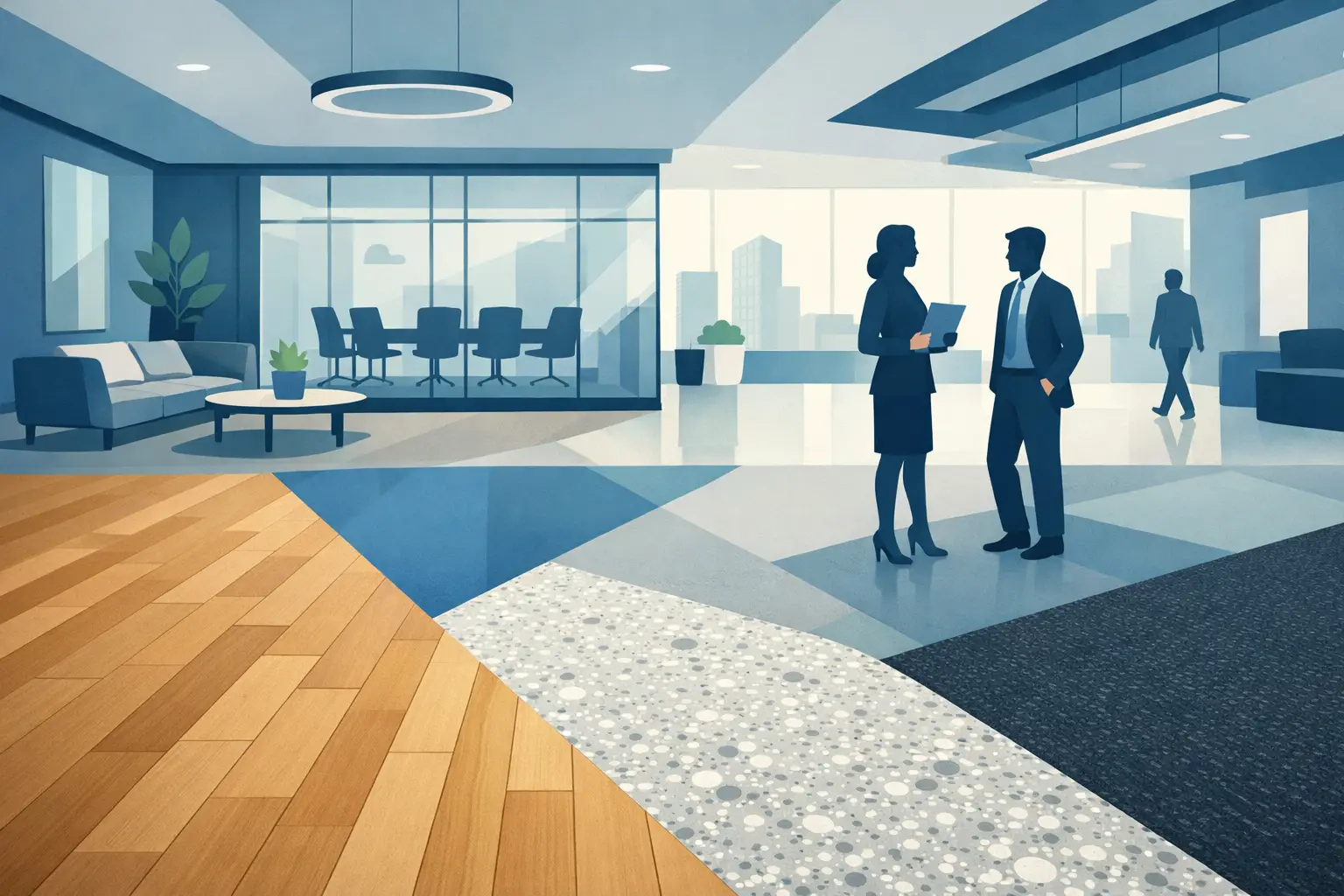
Flooring is increasingly being used to organise space visually. Rather than relying only on walls, partitions or signage, designers are using changes in material, plank direction, pattern and colour to define transitions.
In a workplace, that might mean moving from resilient plank flooring in reception and circulation areas to carpet tile in focused work zones. In education or healthcare, colour and surface variation can guide users through a building more intuitively. In retail, flooring changes can help separate product areas or customer pathways without interrupting the overall layout.
This approach works best when it is subtle. Strong contrasts can be effective, but overuse can make a space feel fragmented. The more successful schemes use flooring transitions to support how the building functions, not just to add visual variety.
Sustainable thinking is influencing specification
Sustainability is no longer treated as a specialist concern. More commercial clients are asking where materials come from, how long they last, what maintenance they require and whether sections can be repaired or replaced without removing the full floor.
This does not always lead to one material type over another. In practice, sustainable specification is usually about the whole lifecycle. A longer-lasting floor with manageable maintenance and straightforward refurbishment may be the better decision than a cheaper product that needs early replacement.
Refurbishment is also part of this discussion. In some spaces, restoring or upgrading an existing surface can be a more practical route than full removal, provided the floor condition and intended use make that feasible.
Installation speed and business continuity are shaping choices
Many commercial projects operate under tight timelines. Fit-outs need fast turnover. Existing businesses want minimal disruption. Property managers want areas reopened quickly.
This has pushed interest towards floor systems that are efficient to install and easier to phase across occupied sites. SPC, vinyl and modular carpet solutions often suit these projects because they can support quicker programmes and simpler future repairs. That said, speed should not override substrate preparation or correct system build-up. Fast installation only helps if the floor performs properly afterwards.
For that reason, supply and installation need to be considered together. A technically suitable product can still fail if site conditions, adhesives, moisture control or finishing details are handled poorly. Experienced specification support matters just as much as the material selection itself.
How to apply these trends without over-specifying
The best response to commercial flooring design trends is not to follow all of them at once. It is to match the floor to the building’s daily demands.
Start with traffic, cleaning method and expected wear. Then look at design intent, acoustic needs and budget. A corporate office, a private clinic and a school may all want a modern, natural-looking finish, but the right system for each will differ. One may benefit from engineered wood in selected areas, another from heavy-duty vinyl or SPC, and another from carpet tile combined with resilient flooring for zoned performance.
This is where a supplier-installer with technical range adds real value. A company such as Professional Surfaces can advise across timber, vinyl, SPC, laminate, carpet and specialist systems, while also considering installation and refurbishment requirements from the start. That helps clients avoid specifying in isolation.
The most useful trend to follow is simple: choose flooring as an operational asset, not just a decorative layer. When the surface supports the way a commercial space is used, the design tends to hold up far better over time.